CVE-2026-24061:GNU InetUtils Telnetd 身份验证绕过漏洞
漏洞描述
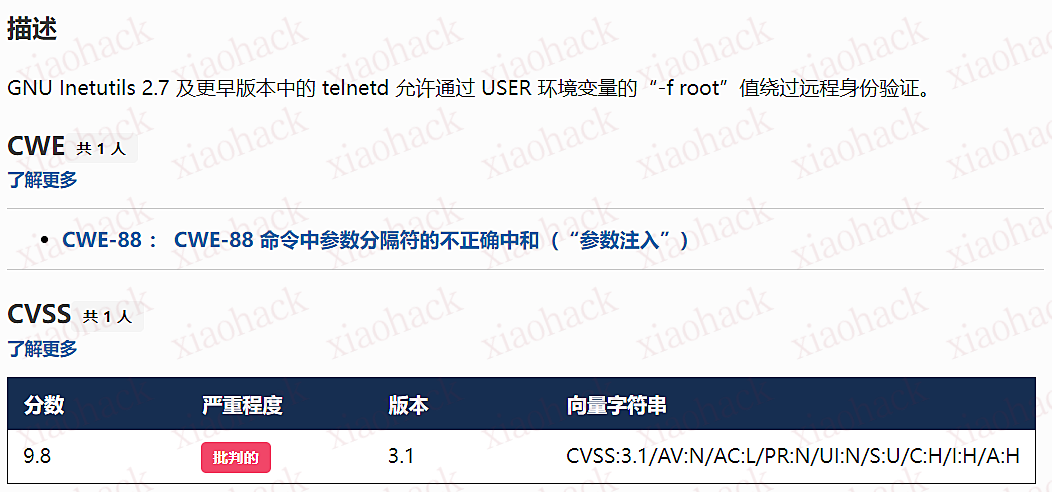
GNU InetUtils telnetd(版本 1.9.3 至 2.7)存在高危远程认证绕过漏洞。攻击者可通过 Telnet 协议的环境变量协商机制,在连接阶段注入恶意 USER 环境变量(如 USER="-f root")。由于 telnetd 在处理 NEW_ENVIRON 子选项时未对客户端提供的环境变量值进行任何安全校验,并且在启动登录进程时直接使用该变量构造 /bin/login 命令,导致系统执行 login -f root。而 login 的 -f 参数会跳过身份验证,直接以指定用户身份登录,从而使攻击者无需密码即可获得 root shell,完全控制目标服务器。
漏洞分析
攻击者执行:
USER='-f root' telnet -a 目标服务器IP 23
USER='-f root':设置恶意环境变量
-a 或 --login:告诉telnet客户端发送 USER 环境变量到服务器
首先进行环境变量修改

使用telnetd_setup函数对服务器进行初始化,然后进入telnetd_run函数开始解析用户发送的命令
首先是telnetd_setup函数

在514行

第一处的作用是清除现有USER环境变量
第二处会进行终端类型的获取,并会触发协议处理getterminaltype函数

可以看到该函数在telnetd/utility.c
调到这里,对该函数进行审计
int
getterminaltype (char *uname, size_t len)
{
  int retval = -1;

  settimer (baseline);
#if defined AUTHENTICATION
  /*
   * Handle the Authentication option before we do anything else.
   * Distinguish the available modes by level:
   *
   *   off:         Authentication is forbidden.
   *   none:            Volontary authentication.
   *   user, valid, other:  Mandatory authentication only.
   */
  if (auth_level < 0)
    send_wont (TELOPT_AUTHENTICATION, 1);
  else
    {
      if (auth_level > 0)
    send_do (TELOPT_AUTHENTICATION, 1);
      else
    send_will (TELOPT_AUTHENTICATION, 1);

      ttloop (his_will_wont_is_changing (TELOPT_AUTHENTICATION));

      if (his_state_is_will (TELOPT_AUTHENTICATION))
    retval = auth_wait (uname, len);
    }
#else /* !AUTHENTICATION */
  (void) uname; /* Silence warning.  */
  (void) len;   /* Silence warning.  */
#endif

#ifdef  ENCRYPTION
  send_will (TELOPT_ENCRYPT, 1);
#endif /* ENCRYPTION */
  send_do (TELOPT_TTYPE, 1);
  send_do (TELOPT_TSPEED, 1);
  send_do (TELOPT_XDISPLOC, 1);
  send_do (TELOPT_NEW_ENVIRON, 1);
  send_do (TELOPT_OLD_ENVIRON, 1);

#ifdef ENCRYPTION
  ttloop (his_do_dont_is_changing (TELOPT_ENCRYPT)
      || his_will_wont_is_changing (TELOPT_TTYPE)
      || his_will_wont_is_changing (TELOPT_TSPEED)
      || his_will_wont_is_changing (TELOPT_XDISPLOC)
      || his_will_wont_is_changing (TELOPT_NEW_ENVIRON)
      || his_will_wont_is_changing (TELOPT_OLD_ENVIRON));
#else
  ttloop (his_will_wont_is_changing (TELOPT_TTYPE)
      || his_will_wont_is_changing (TELOPT_TSPEED)
      || his_will_wont_is_changing (TELOPT_XDISPLOC)
      || his_will_wont_is_changing (TELOPT_NEW_ENVIRON)
      || his_will_wont_is_changing (TELOPT_OLD_ENVIRON));
#endif

#ifdef  ENCRYPTION
  if (his_state_is_will (TELOPT_ENCRYPT))
    encrypt_wait ();
#endif

  if (his_state_is_will (TELOPT_TSPEED))
    {
      static unsigned char sb[] =
    { IAC, SB, TELOPT_TSPEED, TELQUAL_SEND, IAC, SE };

      net_output_datalen (sb, sizeof sb);
    }
  if (his_state_is_will (TELOPT_XDISPLOC))
    {
      static unsigned char sb[] =
    { IAC, SB, TELOPT_XDISPLOC, TELQUAL_SEND, IAC, SE };

      net_output_datalen (sb, sizeof sb);
    }
  if (his_state_is_will (TELOPT_NEW_ENVIRON))
    {
      static unsigned char sb[] =
    { IAC, SB, TELOPT_NEW_ENVIRON, TELQUAL_SEND, IAC, SE };

      net_output_datalen (sb, sizeof sb);
    }
  else if (his_state_is_will (TELOPT_OLD_ENVIRON))
    {
      static unsigned char sb[] =
    { IAC, SB, TELOPT_OLD_ENVIRON, TELQUAL_SEND, IAC, SE };

      net_output_datalen (sb, sizeof sb);
    }
  if (his_state_is_will (TELOPT_TTYPE))
    net_output_datalen (ttytype_sbbuf, sizeof ttytype_sbbuf);

  if (his_state_is_will (TELOPT_TSPEED))
    ttloop (sequenceIs (tspeedsubopt, baseline));
  if (his_state_is_will (TELOPT_XDISPLOC))
    ttloop (sequenceIs (xdisplocsubopt, baseline));
  if (his_state_is_will (TELOPT_NEW_ENVIRON))
    ttloop (sequenceIs (environsubopt, baseline));
  if (his_state_is_will (TELOPT_OLD_ENVIRON))
    ttloop (sequenceIs (oenvironsubopt, baseline));

  if (his_state_is_will (TELOPT_TTYPE))
    {
      char *first = NULL, *last = NULL;

      ttloop (sequenceIs (ttypesubopt, baseline));
      /*
       * If the other side has already disabled the option, then
       * we have to just go with what we (might) have already gotten.
       */
      if (his_state_is_will (TELOPT_TTYPE) && !terminaltypeok (terminaltype))
    {
      free (first);
      first = xstrdup (terminaltype);
      for (;;)
        {
          /* Save the unknown name, and request the next name. */
          free (last);
          last = xstrdup (terminaltype);
          _gettermname ();
          if (terminaltypeok (terminaltype))
        break;
          if ((strcmp (last, terminaltype) == 0)
          || his_state_is_wont (TELOPT_TTYPE))
        {
          /*
           * We've hit the end.  If this is the same as
           * the first name, just go with it.
           */
          if (strcmp (first, terminaltype) == 0)
            break;
          /*
           * Get the terminal name one more time, so that
           * RFC1091 compliant telnets will cycle back to
           * the start of the list.
           */
          _gettermname ();
          if (strcmp (first, terminaltype) != 0)
            {
              free (terminaltype);
              terminaltype = xstrdup (first);
            }
          break;
        }
        }
    }
      free (first);
      free (last);
    }
  return retval;
}
其中

send_do (TELOPT_XXX, 1); 这一系列调用向远程Telnet客户端发送了一个“DO”请求,告知客户端“我希望你启用 TELOPT_TTYPE(终端类型)、TELOPT_TSPEED(终端速度)等特性”
ttloop 函数的调用参数 his_will_wont_is_changing(TELOPT_XXX) 是关键。它的作用是检查远程客户端对于特定选项(如TELOPT_TTYPE)的“WILL”(同意)或“WONT”(拒绝)响应状态是否发生了变化。
将 ttloop 的参数设置为这些状态检查的逻辑“或”,意味着 ttloop 会持续循环运行,直到所有发送出去的选项请求都收到了客户的明确响应(无论是同意还是拒绝),也就是状态不再“正在变化”。
因此,ttloop 在此处扮演了同步等待客户端回复的角色,确保协议协商步骤正确完成后再继续。

ttloop函数的实质是循环调用io_drain()

此时io_drain()在utility.c,我们跳到utility.c去查看其函数内容

读取网络数据:将客户端发送来的原始字节流读入缓冲区 (netibuf)
然后执行telrcv()

跳到telnetd/state.c查看其内容
void
  telrcv (void)
{
  register int c;
  static int state = TS_DATA;

  while ((net_input_level () > 0) & !pty_buffer_is_full ())
  {
    c = net_get_char (0);
    #ifdef  ENCRYPTION
    if (decrypt_input)
      c = (*decrypt_input) (c);
    #endif /* ENCRYPTION */
      switch (state)
      {

        case TS_CR:
          state = TS_DATA;
          /* Strip off \n or \0 after a \r */
          if ((c == 0) || (c == '\n'))
            break;
          /* FALL THROUGH */

        case TS_DATA:
          if (c == IAC)
          {
            state = TS_IAC;
            break;
          }
          /*
* We now map \r\n ==> \r for pragmatic reasons.
* Many client implementations send \r\n when
* the user hits the CarriageReturn key.
*
* We USED to map \r\n ==> \n, since \r\n says
* that we want to be in column 1 of the next
* printable line, and \n is the standard
* unix way of saying that (\r is only good
* if CRMOD is set, which it normally is).
*/
          if ((c == '\r') && his_state_is_wont (TELOPT_BINARY))
          {
            int nc = net_get_char (1);
            #ifdef  ENCRYPTION
            if (decrypt_input)
              nc = (*decrypt_input) (nc & 0xff);
            #endif /* ENCRYPTION */
              /*
* If we are operating in linemode,
* convert to local end-of-line.
*/
              if (linemode
                  && net_input_level () > 0
                  && (('\n' == nc) || (!nc && tty_iscrnl ())))
              {
                net_get_char (0);   /* Remove from the buffer */
                c = '\n';
              }
              else
              {
                #ifdef  ENCRYPTION
                if (decrypt_input)
                  (*decrypt_input) (-1);
                #endif /* ENCRYPTION */
                  state = TS_CR;
              }
          }
          pty_output_byte (c);
          break;

        case TS_IAC:
          gotiac:
          switch (c)
          {

              /*
* Send the process on the pty side an
* interrupt.  Do this with a NULL or
* interrupt char; depending on the tty mode.
*/
            case IP:
              DEBUG (debug_options, 1, printoption ("td: recv IAC", c));
              send_intr ();
              break;

            case BREAK:
              DEBUG (debug_options, 1, printoption ("td: recv IAC", c));
              send_brk ();
              break;

              /*
* Are You There?
*/
            case AYT:
              DEBUG (debug_options, 1, printoption ("td: recv IAC", c));
              recv_ayt ();
              break;

              /*
* Abort Output
*/
            case AO:
              {
                DEBUG (debug_options, 1, printoption ("td: recv IAC", c));
                ptyflush ();    /* half-hearted */
                init_termbuf ();

                if (slctab[SLC_AO].sptr
                    && *slctab[SLC_AO].sptr != (cc_t) (_POSIX_VDISABLE))
                  pty_output_byte (*slctab[SLC_AO].sptr);

                netclear ();    /* clear buffer back */
                net_output_data ("%c%c", IAC, DM);
                set_neturg ();
                DEBUG (debug_options, 1, printoption ("td: send IAC", DM));
                break;
              }

              /*
* Erase Character and
* Erase Line
*/
            case EC:
            case EL:
              {
                cc_t ch;

                DEBUG (debug_options, 1, printoption ("td: recv IAC", c));
                ptyflush ();    /* half-hearted */
                init_termbuf ();
                if (c == EC)
                  ch = *slctab[SLC_EC].sptr;
                else
                  ch = *slctab[SLC_EL].sptr;
                if (ch != (cc_t) (_POSIX_VDISABLE))
                  pty_output_byte ((unsigned char) ch);
                break;
              }

              /*
           * Check for urgent data...
           */
            case DM:
              DEBUG (debug_options, 1, printoption ("td: recv IAC", c));
              SYNCHing = stilloob (net);
              settimer (gotDM);
              break;

              /*
           * Begin option subnegotiation...
           */
            case SB:
              state = TS_SB;
              SB_CLEAR ();
              continue;

            case WILL:
              state = TS_WILL;
              continue;

            case WONT:
              state = TS_WONT;
              continue;

            case DO:
          state = TS_DO;
          continue;

        case DONT:
          state = TS_DONT;
          continue;
        case EOR:
          if (his_state_is_will (TELOPT_EOR))
        send_eof ();
          break;

          /*
           * Handle RFC 10xx Telnet linemode option additions
           * to command stream (EOF, SUSP, ABORT).
           */
        case xEOF:
          send_eof ();
          break;

        case SUSP:
          send_susp ();
          break;

        case ABORT:
          send_brk ();
          break;

        case IAC:
          pty_output_byte (c);
          break;
        }
      state = TS_DATA;
      break;

    case TS_SB:
      if (c == IAC)
        state = TS_SE;
      else
        SB_ACCUM (c);
      break;

    case TS_SE:
      if (c != SE)
        {
          if (c != IAC)
        {
          /*
           * bad form of suboption negotiation.
           * handle it in such a way as to avoid
           * damage to local state.  Parse
           * suboption buffer found so far,
           * then treat remaining stream as
           * another command sequence.
           */

          /* for DIAGNOSTICS */
          SB_ACCUM (IAC);
          SB_ACCUM (c);
          subpointer -= 2;

          SB_TERM ();
          suboption ();
          state = TS_IAC;
          goto gotiac;
        }
          SB_ACCUM (c);
          state = TS_SB;
        }
      else
        {
          /* for DIAGNOSTICS */
          SB_ACCUM (IAC);
          SB_ACCUM (SE);
          subpointer -= 2;

          SB_TERM ();
          suboption (); /* handle sub-option */
          state = TS_DATA;
        }
      break;

    case TS_WILL:
      willoption (c);
      state = TS_DATA;
      continue;

    case TS_WONT:
      wontoption (c);
      state = TS_DATA;
      continue;

    case TS_DO:
      dooption (c);
      state = TS_DATA;
      continue;

    case TS_DONT:
      dontoption (c);
      state = TS_DATA;
      continue;

    default:
      syslog (LOG_ERR, "telnetd: panic state=%d\n", state);
      printf ("telnetd: panic state=%d\n", state);
      exit (EXIT_FAILURE);
    }
    }
}
该函数从网络读取攻击者发送的数据并进行解析,下面是解析的过程代码
    case TS_DATA:
      if (c == IAC)
        {
          state = TS_IAC;
          break;
        }
      /*
       * We now map \r\n ==> \r for pragmatic reasons.
       * Many client implementations send \r\n when
       * the user hits the CarriageReturn key.
       *
       * We USED to map \r\n ==> \n, since \r\n says
       * that we want to be in column 1 of the next
       * printable line, and \n is the standard
       * unix way of saying that (\r is only good
       * if CRMOD is set, which it normally is).
       */
      if ((c == '\r') && his_state_is_wont (TELOPT_BINARY))
        {
          int nc = net_get_char (1);
#ifdef  ENCRYPTION
          if (decrypt_input)
        nc = (*decrypt_input) (nc & 0xff);
#endif /* ENCRYPTION */
          /*
           * If we are operating in linemode,
           * convert to local end-of-line.
           */
          if (linemode
          && net_input_level () > 0
          && (('\n' == nc) || (!nc && tty_iscrnl ())))
        {
          net_get_char (0); /* Remove from the buffer */
          c = '\n';
        }
          else
        {
#ifdef  ENCRYPTION
          if (decrypt_input)
            (*decrypt_input) (-1);
#endif /* ENCRYPTION */
          state = TS_CR;
        }
        }
      pty_output_byte (c);
      break;

    case TS_IAC:
    gotiac:
      switch (c)
        {

          /*
           * Send the process on the pty side an
           * interrupt.  Do this with a NULL or
           * interrupt char; depending on the tty mode.
           */
        case IP:
          DEBUG (debug_options, 1, printoption ("td: recv IAC", c));
          send_intr ();
          break;

        case BREAK:
          DEBUG (debug_options, 1, printoption ("td: recv IAC", c));
          send_brk ();
          break;

          /*
           * Are You There?
           */
        case AYT:
          DEBUG (debug_options, 1, printoption ("td: recv IAC", c));
          recv_ayt ();
          break;

          /*
           * Abort Output
           */
        case AO:
          {
        DEBUG (debug_options, 1, printoption ("td: recv IAC", c));
        ptyflush ();    /* half-hearted */
        init_termbuf ();

        if (slctab[SLC_AO].sptr
            && *slctab[SLC_AO].sptr != (cc_t) (_POSIX_VDISABLE))
          pty_output_byte (*slctab[SLC_AO].sptr);

        netclear ();    /* clear buffer back */
        net_output_data ("%c%c", IAC, DM);
        set_neturg ();
        DEBUG (debug_options, 1, printoption ("td: send IAC", DM));
        break;
          }

          /*
           * Erase Character and
           * Erase Line
           */
        case EC:
        case EL:
          {
        cc_t ch;

        DEBUG (debug_options, 1, printoption ("td: recv IAC", c));
        ptyflush ();    /* half-hearted */
        init_termbuf ();
        if (c == EC)
          ch = *slctab[SLC_EC].sptr;
        else
          ch = *slctab[SLC_EL].sptr;
        if (ch != (cc_t) (_POSIX_VDISABLE))
          pty_output_byte ((unsigned char) ch);
        break;
          }

          /*
           * Check for urgent data...
           */
        case DM:
          DEBUG (debug_options, 1, printoption ("td: recv IAC", c));
          SYNCHing = stilloob (net);
          settimer (gotDM);
          break;

          /*
           * Begin option subnegotiation...
           */
        case SB:
          state = TS_SB;
          SB_CLEAR ();
          continue;

        case WILL:
          state = TS_WILL;
          continue;

        case WONT:
          state = TS_WONT;
          continue;

        case DO:
          state = TS_DO;
          continue;

        case DONT:
          state = TS_DONT;
          continue;
        case EOR:
          if (his_state_is_will (TELOPT_EOR))
        send_eof ();
          break;

          /*
           * Handle RFC 10xx Telnet linemode option additions
           * to command stream (EOF, SUSP, ABORT).
           */
        case xEOF:
          send_eof ();
          break;

        case SUSP:
          send_susp ();
          break;

        case ABORT:
          send_brk ();
          break;

        case IAC:
          pty_output_byte (c);
          break;
        }
      state = TS_DATA;
      break;

    case TS_SB:
      if (c == IAC)
        state = TS_SE;
      else
        SB_ACCUM (c);
      break;

    case TS_SE:
      if (c != SE)
        {
          if (c != IAC)
        {
          /*
           * bad form of suboption negotiation.
           * handle it in such a way as to avoid
           * damage to local state.  Parse
           * suboption buffer found so far,
           * then treat remaining stream as
           * another command sequence.
           */

          /* for DIAGNOSTICS */
          SB_ACCUM (IAC);
          SB_ACCUM (c);
          subpointer -= 2;

          SB_TERM ();
          suboption ();
          state = TS_IAC;
          goto gotiac;
        }
          SB_ACCUM (c);
          state = TS_SB;
        }
      else
        {
          /* for DIAGNOSTICS */
          SB_ACCUM (IAC);
          SB_ACCUM (SE);
          subpointer -= 2;

          SB_TERM ();
          suboption (); /* handle sub-option */
          state = TS_DATA;
        }
      break;
这里通过解析 TELNET 协议,去提取环境变量,然后进入suboption函数处理子选项
这里是漏洞的核心点

case TELOPT_NEW_ENVIRON:
case TELOPT_OLD_ENVIRON:
{
    // ... (前面的协议解析代码)
    while (!SB_EOF()) {
        c = SB_GET();
        // ... 解析出 varp (变量名) 和 valp (变量值) ...
    }
    *cp = '\0';
    if (valp)
        setenv(varp, valp, 1); // <--- !!!漏洞核心触发点!!!
    else
        unsetenv(varp);
    break;
}
setenv(varp, valp, 1);被无条件执行,意味着:
- 无来源验证:代码没有检查这个
SEND指令是否应该由客户端主动发起。在Telnet协议中,通常应由服务器发送SEND来请求变量,客户端用IS回应。这里客户端却“命令”服务器设置变量,而服务器接受了。 - 无内容过滤:代码没有对
valp(即-f root)的内容进行任何安全检查。它没有过滤以破折号(-)开头的值,而这类值正好可以被login程序解析为命令行参数。 - 无权限检查:代码直接设置了环境变量,特别是敏感的
USER变量,而没有验证其值是否合理(例如,是否是一个合法的用户名)。
相当于攻击者发送
IAC SB NEW-ENVIRON SEND VAR "USER" VALUE "-f root" IAC SE
后端就会进行如下解析:
1. 遇到 USERVAR → 识别为新变量开始
2. 收集 "USER" 到 varp
3. 遇到 VALUE → 切换到值收集模式
4. 收集 "-f root" 到 valp
5. 循环结束,执行:setenv("USER", "-f root", 1)
从而使得环境变量被恶意设置
然后启动登录进程

登录口

跳转到telnetd/pty.c进行审计
void
start_login (char *host, int autologin, char *name)
{
  char *cmd;
  int argc;
  char **argv;

  (void) host;      /* Silence warnings.  Diagnostic use?  */
  (void) autologin;
  (void) name;

  scrub_env ();

  /* Set the environment variable "LINEMODE" to indicate our linemode */
  if (lmodetype == REAL_LINEMODE)
    setenv ("LINEMODE", "real", 1);
  else if (lmodetype == KLUDGE_LINEMODE || lmodetype == KLUDGE_OK)
    setenv ("LINEMODE", "kludge", 1);

  cmd = expand_line (login_invocation);
  if (!cmd)
    fatal (net, "can't expand login command line");
  argcv_get (cmd, "", &argc, &argv);
  execv (argv[0], argv);
  syslog (LOG_ERR, "%s: %m\n", cmd);
  fatalperror (net, cmd);
}
scrub_env ();
清理危险环境变量

进入该函数之后可以看见,其未对USER过滤!!!
模板展开引擎
得知未对USER过滤,那么攻击者构造的恶意USER就会被传入,下面是登录时对登录模板进行解析的流程

// 登录模板默认配置
login_invocation = " -p -h %h %?u{-f %u}{%U}"

// 当没有认证用户时(%u为空)

cmd = expand_line (login_invocation);

exp.cp = (char *)line;
    _expand_block(&exp);
该函数对login_invocation开始展开


_expand_cond (exp);
展开条件

- 解析前半部分:
模板引擎逐字复制 -p -h
遇到 %h,调用 _expand_var(exp),将其展开为客户端的主机名或IP地址(例如 192.168.1.100)。此时中间结果为 -p -h 192.168.1.100
- 进入条件块
**%?u**(关键决策点):
遇到 %?u,_expand_cond() 被调用
_expand_cond() 看到 ?,知道这是一个条件判断。它先尝试展开 %u
%u 代表“已认证的用户名”。在攻击场景下,攻击者没有进行任何认证,因此 _expand_var() 在处理 %u 时返回 NULL
由于 p 为 NULL(%u 无值),_expand_cond() 执行 else 分支:
_skip_block(exp):跳过第一个块 {-f %u}。这个块本意是“如果已认证,就添加 -f 参数和用户名”
_expand_block(exp):展开第二个块 {%U}
- 展开
**{%U}**(恶意变量注入):
_expand_block() 开始处理 {%U} 内的内容
遇到 %U,再次调用 _expand_cond()(此时没有 ?,进入else分支)
_expand_var(exp) 被调用以处理 %U
%U 的含义是:USER 环境变量的值。
由于漏洞前期 suboption() 函数已成功设置了 USER='-f root',且 scrub_env() 未将其清除,此时 getenv("USER") 返回的正是 -f root
因此,%U 被展开为字符串 -f root,并附加到结果中

p = _var_short_name (exp);

- 最终拼接:
将所有部分拼接起来,最终的登录命令变为:login -p -h 192.168.1.100 -f -f root(第一个 -f 默认参数,第二个 -f root 来自注入的变量。对于 login 程序,-f 意味着“跳过密码验证”,其后的 root 是要登录的用户。)
官方修复
完全修复

1. 修复策略:源头修复
补丁没有仅仅修复 USER 变量,而是创建了一个通用的 sanitize() 函数,对所有可能被用于构建命令行的变量进行统一过滤。
static char * sanitize (const char *u) {
    /* 忽略以 '-' 开头或包含Shell元字符的值,因为它们可能引发问题 */
    if (u && *u != '-' && !u[strcspn (u, "\t\n !\"#$&'()*:;<=>?[\\^`{|}~")])
        return u;
    else
        return ""; // 或返回空字符串
}
2. 修复范围:全面覆盖
补丁将 sanitize() 函数应用到了 _var_short_name() 函数中所有从不可信来源获取的变量
这种全面过滤的策略防止了攻击者未来可能从其他参数寻找注入点。
3. 过滤规则:双重检查
sanitize() 函数执行两个关键检查:
- 不以破折号开头 (
*u != '-'):防止值被解释为命令行参数(如-f、--option)。 - 不包含Shell元字符:使用
strcspn()检查是否包含空白字符和! \" # $ & ' ( ) * ; < = > ? [ \ ^{ | } ~` 等可能被Shell用于命令分隔、重定向或扩展的特殊字符。
临时修复

case 'U':
{
    /* Ignore user names starting with '-' or containing shell
       metachars, as they can cause trouble. */
    char const *u = getenv("USER");
    return xstrdup((u && *u != '-'
                    && !u[strcspn(u, "\t\n !\"#$&'()*;<=>?[\\^`{|}~")])
                   ? u : "");
}
修复逻辑:
- 检查是否以
-开头:*u != '-' - 检查是否包含Shell元字符:
!u[strcspn(u, "危险字符集")] - 如果检查失败,返回空字符串:
? u : ""
参考
https://www.openwall.com/lists/oss-security/2026/01/20/2
https://codeberg.org/inetutils/inetutils/commit/ccba9f748aa8d50a38d7748e2e60362edd6a32cc
https://codeberg.org/inetutils/inetutils/commit/fd702c02497b2f398e739e3119bed0b23dd7aa7b